by: Jessie Simmons
Category: National Politics
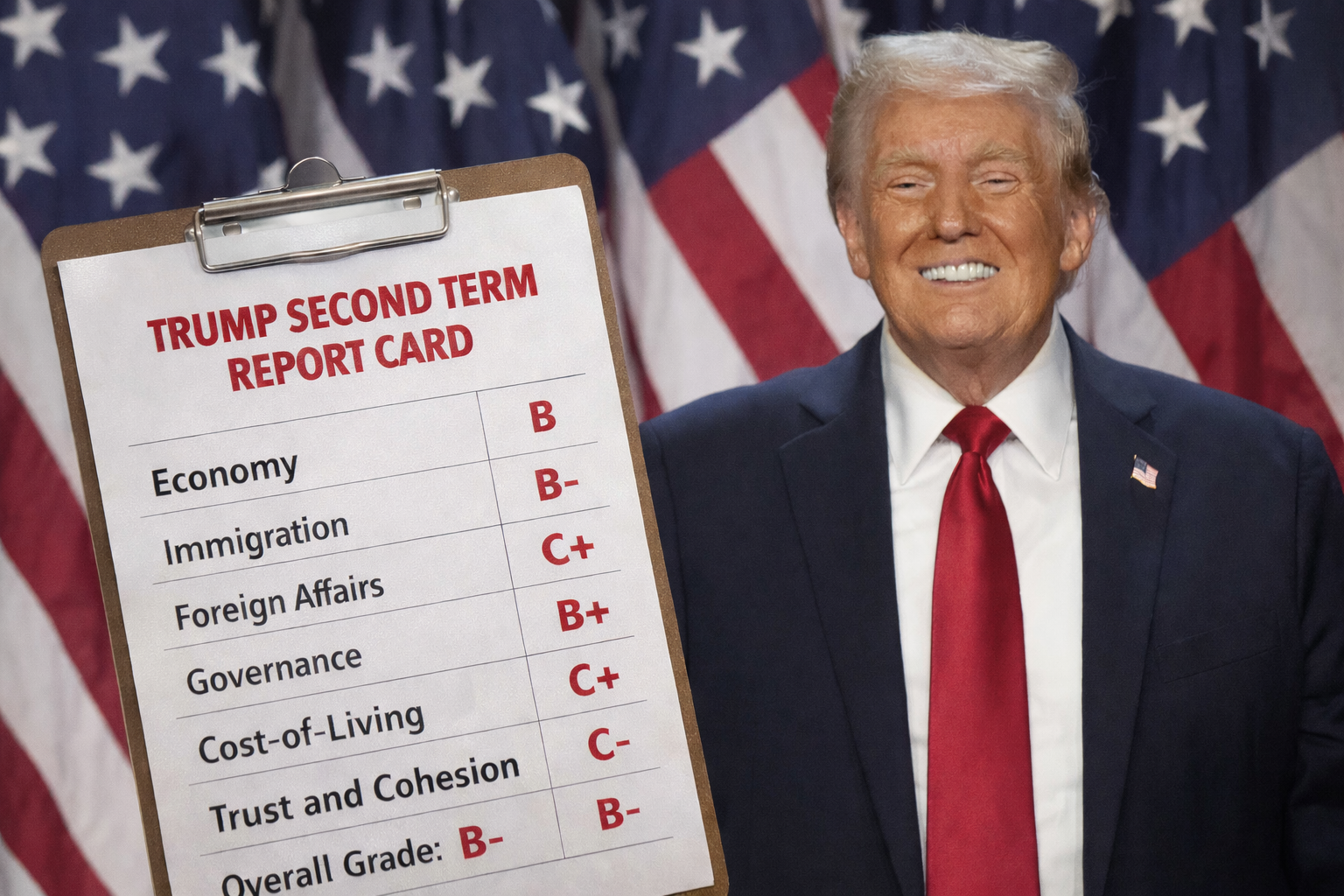
Public debates about presidents usually collapse into personality fights. People grade the person they like generously and the person they dislike harshly, then work backward to justify the score. That approach feels satisfying, but it produces terrible analysis. This piece takes a different path. What follows is a structured, institutional evaluation of the first year of President Donald Trump’s second term, covering the period from January 21, 2025 through January 21, 2026. The grading is intentionally narrow in scope, historically grounded, and consistent with how past presidents are evaluated in comparable first-year windows.
This is not a defense of Trump, and it is not a condemnation either. It is an attempt to answer a harder question:
How did this first year perform when measured against presidents as presidents, not against personal expectations, political identity, or cultural reaction?
Methodology and guardrails
A few rules matter here.
First, the grading window is fixed. Only actions, conditions, and outcomes that occurred or materially changed between January 21, 2025 and January 21, 2026 are considered. Earlier conditions are treated as inherited. Later outcomes are not pulled backward into the grade.
Second, this evaluation separates macroeconomic performance from household affordability, execution from intent, and institutional performance from personal style.
Third, the same categories and standards are used across administrations. No special curve, no personality multiplier, and no retroactive blame or credit.
Finally, affordability, trust, and polarization are treated as real outcomes, but they are not double counted across every category. Where they belong, they are graded directly.
With that in mind, here is the full first-year assessment.
Economy
Grade: B
Measured against presidents as a whole, economic conditions during this year were stable and above the historical median for a non-crisis period. Growth and employment largely reflect inherited macroeconomic conditions, which is typical for first-year presidencies. What elevates the grade is the enactment of a large, unified domestic policy package that establishes a clear fiscal and economic direction. While long-term deficit and distributional impacts remain contested, passing a major economic framework places this year above presidents who relied primarily on stewardship without legislative anchoring. This grade does not ignore affordability. It simply does not allow decades-long structural price problems to erase macro stability in a single year.
Immigration and Border Policy
Grade: B minus
Historically, immigration policy has shifted more through executive discretion than statutory change. Trump’s second-term approach falls within the long-standing enforcement spectrum present since the 1980s. The administration expanded enforcement eligibility and reduced reliance on categorical relief, aligning more closely with Bush-era practices and departing from the permissive end of recent administrations. Compared to Trump’s first term, execution is more coherent and legally anticipatory, with fewer abrupt reversals. The grade is capped because system-wide outcomes such as court backlogs, labor impacts, and humanitarian effects cannot yet be fully assessed.
Foreign Affairs and National Security
Grade: C plus, high variance
This category reflects both high-impact action and unresolved risk. The removal of Nicolás Maduro from power represents one of the most consequential hemispheric interventions by a U.S. president in decades and has immediate geopolitical significance. At the same time, the administration engaged in active diplomacy, contributing to conflict-reduction efforts in multiple regions. However, the United States remains engaged in multiple active or high-tension theaters, and the durability of both coercive and diplomatic outcomes is not yet clear. Historically, significance alone does not equal success. The grade reflects impact without presuming long-term stabilization.
Executive Governance and Legislative Effectiveness
Grade: B plus
Relative to presidents overall, this is a strong first year of a second term. The combination of aggressive executive action and passage of a major legislative package demonstrates improved coordination, sequencing, and coalition maintenance compared to Trump’s first term. Historically, many second-term presidents struggle to enact large-scale legislation early. Clearing that threshold places this year above average. Durability remains an open question, but institutional learning is evident.
Rule of Law and Institutional Stability
Grade: C
This category assesses norms, litigation load, and institutional stress rather than policy outcomes. Trump continues to score below the historical median due to elevated executive-judicial conflict and a governing style that places strain on institutional trust. At the same time, constitutional mechanisms continue to function. Courts constrain executive action, elections proceed, and there is no evidence of systemic institutional failure.
This grade reflects sustained tension, not collapse.
Leadership and Administrative Effectiveness
Grade: B minus
Leadership here is measured by the ability to translate priorities into enacted and implemented policy. Compared to Trump’s first term, internal alignment and follow-through have improved, particularly in legislative coordination and agency direction. Communication discipline and interagency integration remain uneven. Historically, this places the administration slightly above the presidential median but below highly technocratic or consensus-oriented presidencies.
Addressing Major Cost-of-Living Drivers
Grade: C plus
This category directly addresses what people are feeling every day. The administration demonstrated greater willingness than most to engage affordability through legislation rather than relying solely on macroeconomic cooling. However, the largest cost drivers for households, especially housing and healthcare, remain largely unresolved at the federal level. That limitation is consistent across presidencies and not unique to this administration. The grade reflects engagement without overclaiming resolution.
Fiscal Sustainability and Long-Term Debt
Grade: C
While the administration showed willingness to legislate at scale, the long-term fiscal trajectory remains largely unchanged. Major legislation does not materially reverse debt growth trends that have persisted across administrations since the early 2000s. Historically, few presidents earn high marks here absent sustained fiscal consolidation. This year aligns with the modern presidential norm.
Federalism and State–Local Balance
Grade: C plus
The administration rhetorically emphasizes decentralization, but practice is mixed. Some policies defer to state discretion, while others centralize enforcement or regulatory authority. This places Trump near the historical median. The federal posture neither meaningfully empowers nor systematically overrides state and local governance across policy domains.
Regulatory Stability and Business Predictability
Grade: B minus
Relative to Trump’s first term, regulatory clarity has improved. Policy direction is more consistent, and agencies provide clearer signals to regulated entities. However, frequent legal challenges and rapid reversals still introduce uncertainty. Historically, this places the administration above presidents marked by constant regulatory flux, but below those who paired reform with long-term stability.
Crisis Management and National Resilience
Grade: C plus
The administration demonstrates decisiveness in responding to international and enforcement-related crises. However, resilience is measured not just by action, but by second-order effects and durability. At this stage, outcomes remain uncertain. Historically, crisis management grades often change significantly as longer-term consequences emerge.
Civil Liberties and Individual Rights
Grade: C
Enforcement-forward policies increase scrutiny of civil liberties, particularly in immigration and national security contexts. While actions generally operate within existing legal frameworks, implementation risks remain. Historically, this places the administration near the median, reflecting ongoing tension between enforcement priorities and rights protections.
Institutional Capacity and Talent Management
Grade: B minus
Compared to Trump’s first term, staffing discipline and institutional familiarity have improved. Agency leadership is more aligned with policy objectives, and turnover is reduced. Politicization concerns and capacity gaps persist. Historically, this reflects moderate improvement rather than excellence.
Public Trust and National Cohesion
Grade: C minus
This is the administration’s weakest category. Polarization remains high and institutional confidence shows limited recovery. While trust erosion predates Trump and persists across administrations, improvement has been limited in this first year.
Overall assessment
Overall grade: B minus
Measured against U.S. presidents as a whole, Trump’s first year of his second term is above average in agenda execution, legislative effectiveness, and policy significance. It is not transformational by historical standards, but it is more disciplined and consequential than his first-term opening year and stronger than most second-term first years. The evaluation diverges sharply from many detractor grades because it separates governance from grievance, performance from personality, and historical comparison from moral objection. That distinction does not invalidate criticism. It simply produces a clearer picture.
This was a consequential year, not a perfect one. And judged by the same standards applied to every other modern president, that distinction matters.
