Civility as Method, Not Aesthetic
The Government Affairs Desk was created with a simple premise: public policy cannot be understood, evaluated, or improved without discipline. Not ideological discipline. Analytical discipline.
Every functional system relies on restraints. Not because people are incapable of freedom, but because freedom without structure becomes unworkable at scale. Traffic laws exist not to suppress movement, but to make movement possible among strangers who do not know one another and may never agree. Public discourse operates under the same principle. Civility is not an ornament of politics. It is an operating condition.
In the current political environment, that condition is under strain. Outrage is rewarded. Volume substitutes for substance. Performance eclipses process. The sharpest accusation travels farther than the most careful analysis. In that environment, restraint is often misread as weakness, and refusal to inflame is treated as complicity.
That misreading is dangerous.
Moments of moral certainty are precisely when restraint matters most. When stakes feel existential, the temptation is to abandon standards altogether. To conclude that tone no longer matters. That harm is acceptable if the cause feels righteous. History offers no evidence that this approach produces durable justice. When norms collapse, they rarely take only bad actors with them. They take trust, legitimacy, and self-control as well.
This publication rejects the idea that seriousness requires cruelty, or that accountability requires dehumanization.
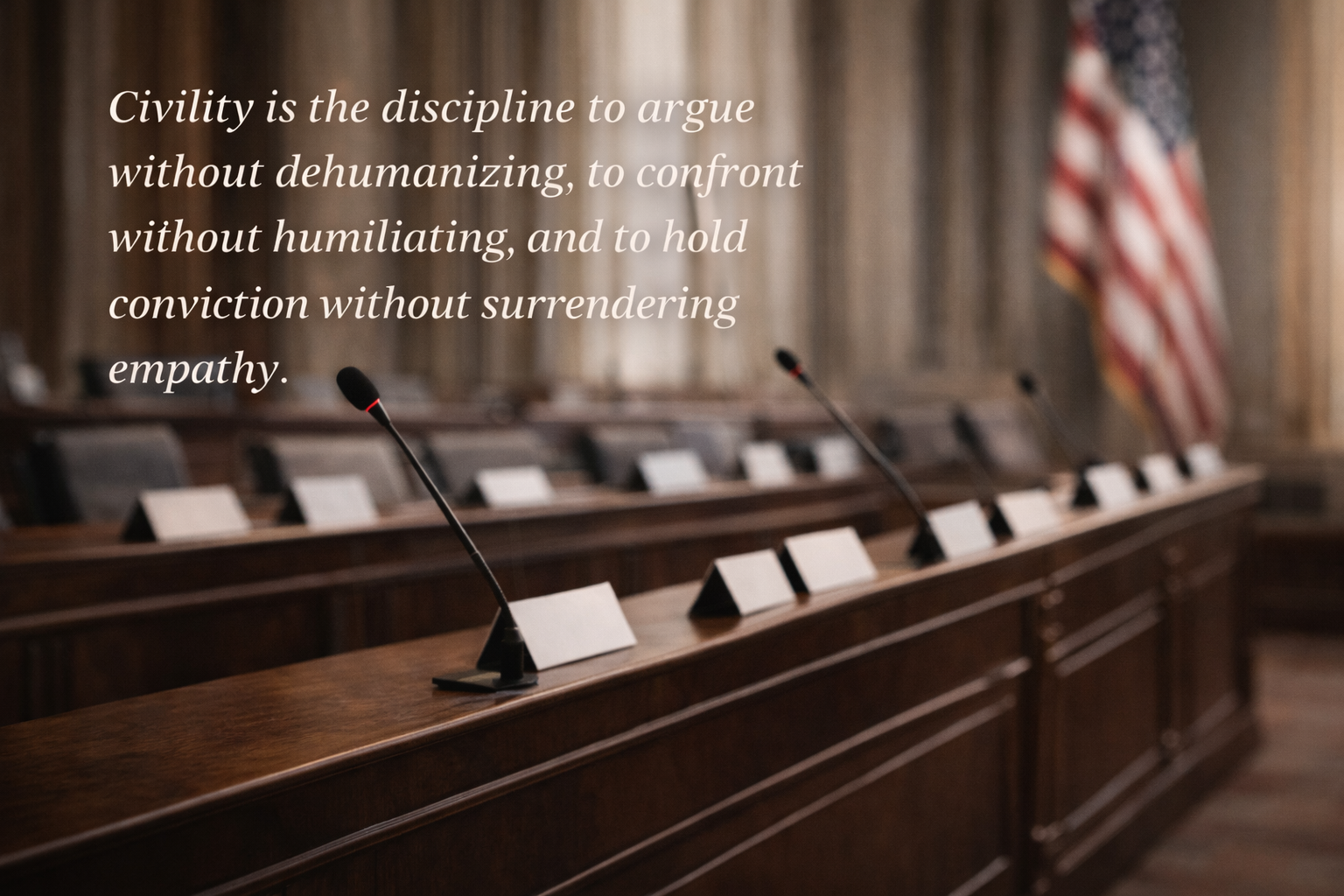
Civility, as understood here, is not silence. It is not passivity. And it is not false balance. It is the discipline to argue without degrading, to criticize without humiliating, and to assess outcomes without assigning moral character where structure, incentives, or implementation failures provide better explanations. It is the ability to hold conviction without abandoning empathy, and to apply scrutiny without collapsing into performance.
Those are not instincts. They are learned behaviors. They must be modeled and enforced, particularly when political incentives reward the opposite.
When leaders dismiss restraint, when institutions tolerate performative outrage, and when cruelty is excused as authenticity, disagreement ceases to be productive. Compromise becomes betrayal. Nuance becomes weakness. Anger becomes currency. At that point, politics no longer produces solutions. It produces adversaries.
A society governed by raw power is unstable by definition. It does not reliably protect the vulnerable, and it does not guarantee safety for the strong. No one can assume they will always benefit when norms erode.
For that reason, civility is not treated here as tone management. It is treated as governance logic.
The Government Affairs Desk applies this principle through its Editorial Standards. Policy decisions are evaluated based on evidence, implementation, and measurable impact. Effective leadership is acknowledged wherever it occurs. Poor decisions, unintended consequences, and structural failures are examined with the same rigor, regardless of party, personality, or intent. Disagreement is expected. Personal degradation is not.
Words shape behavior. Small actions establish norms. How disagreements are conducted determines whether pluralistic systems can function under pressure. This work proceeds from the belief that accountability is strengthened, not weakened, by restraint.
Civility will not resolve every conflict. But without it, no conflict is resolvable.
That is the standard this publication holds itself to. And it is the expectation readers should bring to every analysis published here.
— Jessie Simmons
