Why Washington Has Become So Expensive
By: Jessie Simmons
The Government Affairs Desk
Category: Affordability & Cost of Living
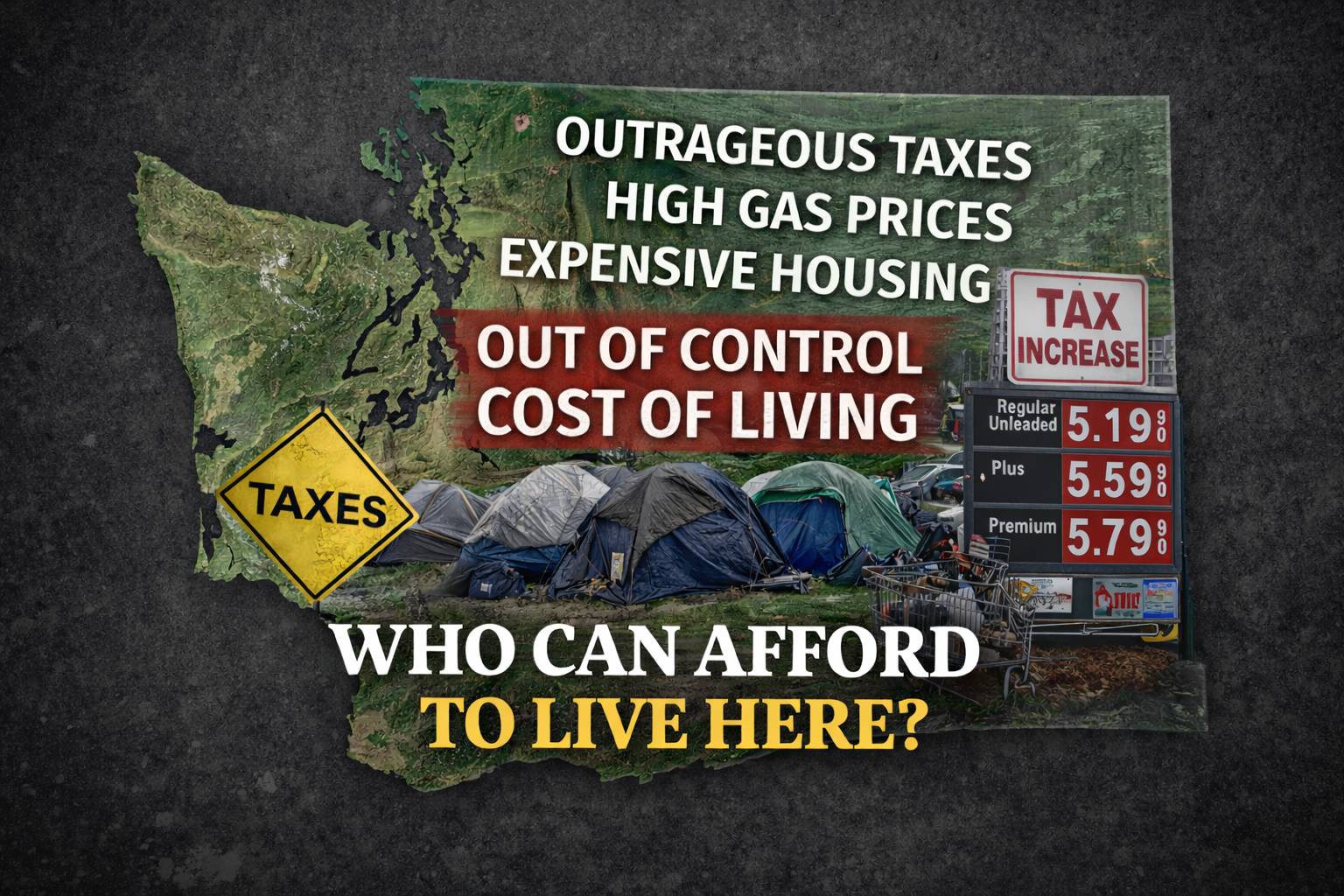
How policy decisions, pandemic-era choices, and compounding costs reshaped affordability for Washington families
Washington State is often described as prosperous, innovative, and economically resilient. Those descriptors are not false. But they are increasingly disconnected from lived reality for many residents.
Today, affordability is the defining issue for working families across Washington. Housing costs consume a growing share of income. Childcare rivals rent or mortgage payments. Healthcare expenses continue to rise even for insured households. Transportation, utilities, and basic services strain budgets month after month. At the same time, businesses are closing, new business formation has slowed, and more taxes and fees are already scheduled to take effect.
This moment did not arrive suddenly. It is the product of long-running structural constraints, amplified by pandemic-era policy choices, and reinforced by post-COVID decisions that prioritized revenue generation and program expansion over affordability and economic recovery.
Washington Before the Pandemic
For much of the late twentieth century, Washington balanced economic growth with relative affordability. Housing supply generally kept pace with population growth. Regulatory systems were simpler. Infrastructure investment often preceded growth. While costs rose over time, the relationship between wages and expenses remained workable for many households.
That balance began to weaken well before COVID. Housing production lagged population growth following the Great Recession. Environmental regulation layered steadily. Local opposition to growth hardened. The Growth Management Act increasingly functioned as a constraint rather than a guide.
By 2019, Washington already faced housing shortages, rising childcare costs, and regional transportation strain. The system was fragile.
COVID did not create Washington’s affordability problem. It exposed and accelerated it.
The Pandemic Shock and Policy Response
The COVID pandemic disrupted every aspect of economic life. Emergency measures were necessary. But emergency decisions also carry long-term consequences.
Shutdowns, capacity restrictions, and prolonged uncertainty hit small and mid-sized businesses particularly hard. Many never reopened. Others survived by taking on debt they are still servicing. Workforce disruptions reshaped labor markets. Supply chains tightened. Construction costs surged.
At the same time, government spending expanded dramatically. Temporary programs became embedded. Emergency flexibility gave way to permanent expectations. As federal relief receded, Washington increasingly relied on state-level revenue mechanisms to sustain elevated spending levels.
The result was a structural shift: higher baseline costs combined with reduced economic resilience.
Housing Supply Still Never Recovered
Housing remains the single largest affordability driver in Washington.
Homebuilding collapsed during the Great Recession nationwide, but Washington never fully restored production to match population growth. Over the past decade, the state consistently added households faster than homes. That gap widened during and after COVID as labor shortages, material costs, permitting delays, and regulatory complexity intensified.
Small and mid-sized builders exited the market. Financing tightened. Timelines lengthened. Litigation risk became routine. Even modest projects faced years of delay.
Scarcity became entrenched.
Housing prices rose accordingly. Renters absorbed increases. First-time buyers were locked out. Workers were pushed farther from jobs, increasing transportation costs and eroding quality of life.
Anti-Growth Sentiment and Environmental Constraint
Local opposition to growth has become a powerful force in many Washington communities. New housing is frequently framed as a threat rather than a necessity, even in areas designated for growth.
Environmental protection is a core value in Washington, but environmental policy has increasingly been used as a tool to stop growth altogether. Environmental review, habitat conservation requirements, buffers, and mitigation measures have constrained buildable land and extended timelines, particularly near urban centers where demand is highest.
In some cases, environmental frameworks are used strategically to delay or block housing regardless of scale or compliance.
Each layer may be defensible on its own. Together, they function as a system of constraint.
Growth Management Without Delivery
The Growth Management Act was designed to coordinate growth, infrastructure, and environmental protection. In practice, it has evolved into a mechanism that often prevents growth rather than guiding it.
Compliance complexity, inconsistent local implementation, and constant litigation risk create uncertainty that discourages investment. Growth is designated on paper, but frequently blocked in reality.
When growth management prioritizes restriction over delivery, affordability deteriorates.
Costs Beyond Housing Continue to Rise
Childcare costs in Washington routinely rival housing costs for families with young children. Staffing ratios, safety standards, real estate costs, and thin margins make expansion difficult even when demand is overwhelming. Workforce participation suffers as families make impossible tradeoffs.
Healthcare costs continue to rise through premiums, deductibles, and out-of-pocket expenses. Workforce shortages, regional access gaps, and regulatory structure contribute to both cost and access challenges.
Transportation costs increase as housing pushes workers farther from employment centers. Long commutes, fuel costs, vehicle maintenance, and limited alternatives add another layer of strain.
Each system compounds the others.
Climate Policy, the Climate Commitment Act, and Cost Transmission
Washington adopted some of the most ambitious climate policies in the country. The Climate Commitment Act was designed to reduce emissions and fund public investments. In practice, it has also become a significant cost driver.
Compliance costs ripple through fuel prices, goods movement, construction, and utilities. Those costs are not abstract. They show up in higher prices for energy, transportation, and everyday goods. For families with long commutes or limited alternatives, the impact is immediate.
The promise was that revenues would be strategically reinvested. The reality is that costs arrived faster and more broadly than relief.
The CCA has functioned less as a targeted environmental instrument and more as a general cost multiplier layered onto an already expensive system.
A Regressive Tax Structure Under Pressure
Washington’s tax system relies heavily on consumption-based taxes and fees. As new programs are created, additional narrow taxes are layered on top of existing ones.
Individually, these taxes are often modest. Collectively, they are significant.
Because these taxes are regressive, they fall most heavily on working families. Costs show up at the pump, on utility bills, in housing prices, and in everyday transactions. Households experience them not as policy choices, but as a steady erosion of purchasing power.
More taxes and fees are already scheduled or proposed, even as affordability deteriorates.
Spending More, Solving Less
Washington spends billions addressing climate change, homelessness, healthcare, and social services. These priorities are real. But outcomes often lag investment.
Homelessness spending has increased dramatically while the problem persists or worsens. Climate spending expands while cost impacts ripple through the economy. Programs manage symptoms without addressing root causes.
The pattern is familiar: rising expenditures, limited accountability, and persistent crises.
Affordability erodes through accumulation.
Where We Are Now
The current moment is defined by warning signs that cannot be ignored.
Businesses are closing. Business starts have slowed. Capital is increasingly cautious. Families are stretched thin. More taxes and fees are on the horizon. Housing remains scarce. Costs continue to rise faster than incomes.
This is not sustainable.
Washington’s affordability challenge is no longer theoretical. It is structural, systemic, and visible.
What Comes Next
The Government Affairs Desk will examine these issues in detail through focused reporting on housing, childcare, healthcare, transportation, taxation, environmental regulation, climate policy, and budget priorities.
Coverage will emphasize implementation, tradeoffs, and measurable outcomes. Effective leadership will be acknowledged wherever it occurs. Policy failures will be examined directly, without dehumanization and without deference.
Affordability is not an abstract debate. It determines whether families can remain in their communities, whether businesses can operate, and whether opportunity remains accessible in Washington State.
Understanding how we arrived here is the first step toward deciding what must change.
