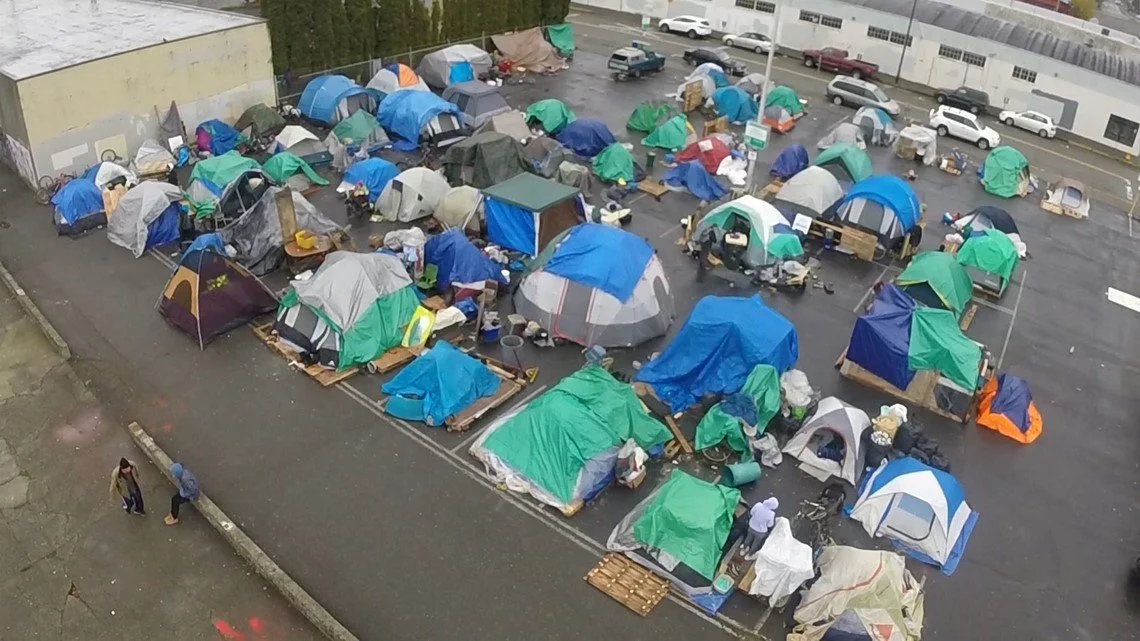
Image credit: King 5
by: Jessie Simmons
Category: Housing Affordability, Homelessness, Washington Legislature
Washington lawmakers are right about one thing: homelessness in this state is being driven by a severe shortage of housing and rising costs that have pushed more people into instability. Where the conversation continues to break down is in how policy responds to that reality.
House Bill 2489 is a clear example of that disconnect.
At a high level, HB 2489 establishes statewide limits on when cities and counties may enforce laws regulating the use of public space for “life-sustaining activities” like sleeping, sitting, or resting. Enforcement is prohibited unless a local government can demonstrate that “adequate alternative shelter space” was available at the time and place of enforcement. The bill applies broadly, includes retroactive application to existing ordinances, and allows for injunctive relief and attorneys’ fees if a city or county violates the standard.
The bill is framed as a humane, evidence-based response to homelessness. The intent language emphasizes compassion, consistency, and the failure of enforcement-first approaches. Those concerns are not imaginary. Criminalizing poverty does not solve homelessness, and Washington has plenty of proof that citations and arrests do not produce housing.
But acknowledging what doesn’t work is not the same as advancing what does.
The central problem Washington faces is not a lack of rules about public space. It is a lack of places for people to go. Housing supply is constrained at every level, from emergency shelter to permanent supportive housing to market-rate homes that free up pressure across the system. On that core issue, HB 2489 is silent.
In fact, the bill assumes scarcity as a permanent condition. Rather than pairing enforcement limits with requirements or resources to expand shelter and housing capacity, the bill simply prohibits local action until capacity exists, without creating any obligation for that capacity to materialize. The result is a one-way ratchet: local governments lose authority, but no one gains responsibility to fix the underlying shortage.
The definition of “adequate alternative shelter space” makes this imbalance even more pronounced. The bill requires shelter to accommodate partners, pets, possessions, disabilities, and sustained access with minimal re-application. Many existing shelters do not meet these criteria, not because they are punitive, but because they are operating under funding, staffing, and facility constraints. Under HB 2489, those shelters are effectively deemed legally inadequate, meaning enforcement is off the table indefinitely in many jurisdictions.
That has real community consequences.
Public spaces serve everyone. Parks, sidewalks, business districts, libraries, and transit corridors are shared infrastructure. When local governments are stripped of the ability to manage those spaces, the impacts do not disappear. They shift. Neighborhoods absorb them. Small businesses absorb them. Transit riders absorb them. People with disabilities absorb them when accessibility is compromised. And local officials are left managing conflict without tools or solutions.
None of this moves people into housing.
This is where HB 2489 feels out of step with the broader housing conversation in Washington. In recent years, the legislature has finally begun to acknowledge that zoning, permitting delays, parking mandates, and fragmented local decision-making have constrained housing supply. Middle housing reforms, transit-oriented density, and permitting streamlining all point toward a long-overdue recognition that housing is infrastructure.
HB 2489 does not build on that momentum. It operates in a parallel policy universe where homelessness is treated primarily as a civil-rights enforcement issue rather than the predictable outcome of chronic undersupply. It manages the visibility of the crisis rather than its causes.
That does not make the bill malicious. But it does make it incomplete, and potentially counterproductive.
By removing urgency and authority at the local level without adding capacity or accountability elsewhere, the bill risks normalizing a status quo where encampments persist indefinitely, housing exits remain limited, and public frustration grows. Over time, that dynamic erodes trust in institutions and hardens political divisions, making it even harder to pass the housing reforms that are actually needed.
If Washington lawmakers are serious about addressing homelessness, a different approach is required.
A serious strategy would tie limits on enforcement to real, measurable progress on shelter and housing capacity. It would pair protections with obligations. If the state is going to restrict local authority, it should simultaneously require and fund shelter expansion, behavioral health capacity, and housing delivery at scale.
A serious strategy would focus on exits, not stasis. Emergency shelter is not an endpoint. Neither is permanent non-enforcement of public space rules. The goal must be rapid movement into stable housing, which means accelerating permitting, reducing development costs, aligning infrastructure planning with growth, and allowing housing to be built where people actually live and work.
A serious strategy would hold systems accountable for outcomes, not intentions. That means conditioning funding and regulatory relief on whether housing actually gets built, whether shelter beds actually come online, and whether people actually move indoors.
HB 2489, as drafted, does none of that.
It tells local governments what they cannot do, while declining to say who must do what next. It treats scarcity as a given rather than a failure to be corrected. And in doing so, it risks perpetuating the very conditions it claims to oppose.
Washington does not have a compassion problem. It has a supply problem. Until legislation squarely confronts that reality, bills like HB 2489 will continue to manage the symptoms of the housing crisis while leaving the cause untouched.
