by Jessie Simmons
Category: Climate Policy
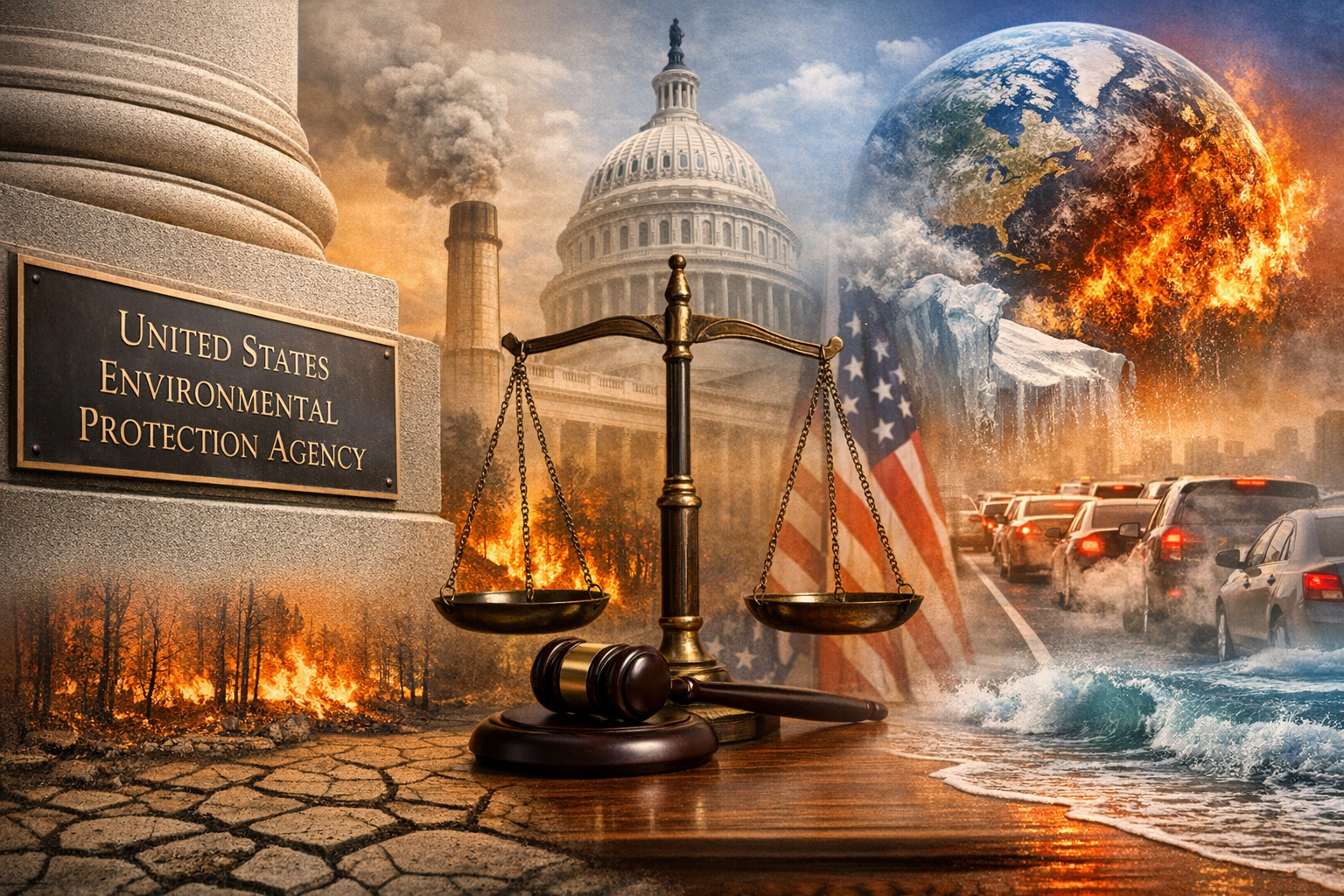
The Environmental Protection Agency has announced it is rescinding the 2009 greenhouse gas “endangerment finding,” the legal foundation for most federal climate regulation over the past 16 years. Predictably, reactions have been immediate and polarized. Some are calling it an assault on science. Others are calling it the largest deregulatory correction in modern history. As usual, the truth requires slowing down and separating what this action does, what it does not do, and what comes next.
First, the science. The 2009 endangerment finding concluded that six greenhouse gases, including carbon dioxide, endanger public health and welfare. That conclusion was based on then-existing climate research and followed the Supreme Court’s decision in Massachusetts v. EPA (2007), which held that greenhouse gases qualify as “air pollutants” under the Clean Air Act. Since 2009, the scientific evidence linking greenhouse gas concentrations to warming trends and climate impacts has strengthened, not weakened. Major scientific institutions continue to conclude that human activity is the dominant driver of recent warming and that climate change increases risks from extreme heat, wildfire conditions, flooding, sea level rise, and related health impacts. Nothing about the EPA’s decision changes atmospheric chemistry. The physical science consensus remains intact.
Second, the legal question. The endangerment finding was not a climate law passed by Congress. It was an administrative determination under a 1970 statute, triggered by a Supreme Court interpretation of that statute. Once EPA made the finding, it was required under the Clean Air Act to regulate emissions from motor vehicles, which later expanded into power plants and other sectors. The current administration’s argument is not primarily that climate change is fictional. It is that Congress never clearly authorized the scale of regulatory transformation that followed, and that recent Supreme Court decisions limiting agency authority under the “major questions” doctrine support pulling that authority back. In other words, this is as much about separation of powers as it is about emissions.
Third, what does rescinding the finding actually do. The endangerment finding is the legal cornerstone for regulating greenhouse gases under the Clean Air Act. Removing it weakens or eliminates the federal government’s primary tool for nationwide carbon regulation under that statute. That includes vehicle emission standards and certain power plant rules. It does not eliminate regulation of traditional air pollutants like particulate matter or ozone. It does not erase state authority. And it does not prohibit Congress from passing climate legislation. It does, however, significantly narrow the executive branch’s ability to regulate greenhouse gases without new statutory authority.
Fourth, the economic argument. Supporters of rescission argue that greenhouse gas rules imposed substantial compliance costs on automakers, utilities, and consumers. Stricter vehicle standards can increase upfront vehicle prices, although they often reduce lifetime fuel costs. The administration estimates substantial savings from rolling back these rules. Whether those savings materialize at scale depends on market behavior, fuel prices, technology adoption, and state policy responses. There are real regulatory costs. There are also real long-term climate costs. Serious analysis has to acknowledge both.
Fifth, what happens next. This decision will almost certainly be challenged in court by states and environmental groups. Lower courts previously upheld the original endangerment finding. Whether today’s Supreme Court takes a different view remains uncertain. If the courts side with the EPA, the federal role in climate regulation under the Clean Air Act will be significantly reduced. If the courts reject the rescission, the regulatory framework could be reinstated under a future administration. In either case, policy instability continues.
The broader reality is this: Congress has largely avoided passing comprehensive climate legislation. That vacuum pushed climate policy into administrative rulemaking under an older statute. When major national policy rests primarily on executive interpretation rather than explicit congressional direction, it becomes vulnerable to reversal when political control changes. That is exactly what we are seeing.
This moment is not simply science versus denial. The scientific case that greenhouse gases contribute to climate change is strong. The constitutional debate about how far agencies can go without clear legislative authorization is also real. Durable policy requires both scientific grounding and statutory clarity. Until Congress chooses to legislate directly and explicitly on carbon regulation, climate policy will continue to swing with elections.
If the goal is long-term certainty for industry, investors, and communities, that certainty will not come from administrative rescission or administrative expansion alone. It will come from Congress doing its job.
