by: Jessie Simmons
Category: Voting Rights
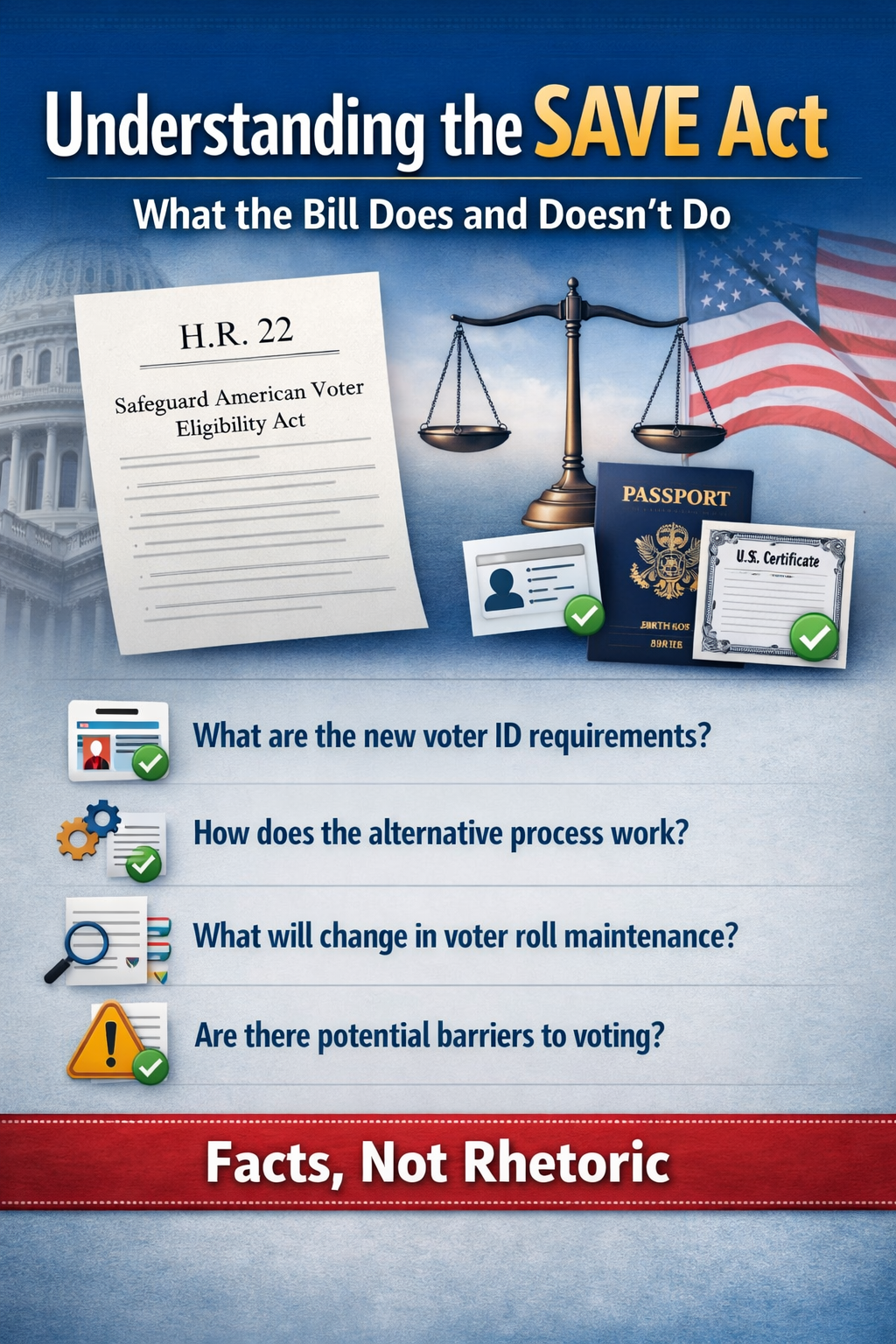
The Safeguard American Voter Eligibility Act, H.R. 22, amends the National Voter Registration Act of 1993. Its core change is straightforward but significant: for federal elections, it replaces self-attestation of citizenship at registration with a requirement for documentary proof of United States citizenship. Everything else in the bill flows from that shift.
Under current federal law, a person registering to vote signs a statement under penalty of perjury affirming that they are a U.S. citizen. The SAVE Act changes that for federal elections. Section 2(b) adds a requirement that a state may not accept and process an application to register to vote in a federal election unless the applicant presents documentary proof of U.S. citizenship with the application. That is the structural change. The bill does not redefine who is eligible to vote. It changes how citizenship must be demonstrated at registration.
Section 2(a) defines “documentary proof of United States citizenship.” The list includes a valid U.S. passport, a naturalization certificate, a certificate of citizenship, a Consular Report of Birth Abroad, certain tribal documentation, and certain military documentation paired with proof of U.S. birth. It also allows a government-issued photo ID showing U.S. place of birth, or a government-issued photo ID paired with a certified birth certificate. It also references a REAL ID–compliant identification that indicates the applicant is a U.S. citizen. The bill does not require a passport specifically, and it does not limit proof to a birth certificate alone. It creates multiple pathways. However, many standard driver’s licenses do not on their face indicate citizenship. In those cases, a voter would likely need to pair the license with a certified birth certificate or rely on another listed document.
The bill modifies multiple registration channels. Section 2(c) alters the “motor voter” process by requiring motor vehicle agencies to verify citizenship when processing voter registration applications. Section 2(d) modifies the federal mail voter registration form. If someone submits the mail form without documentary proof, they must present proof in person to election officials by the state’s registration deadline, or at the polling place in states that allow same-day registration. Mail registration alone would not complete federal registration without accompanying documentation. That is a procedural tightening.
The Act recognizes that not every eligible citizen will have documentary proof readily available. Section 2(f), adding new NVRA Section 8(j)(2), requires each state to establish an alternative process for applicants who cannot provide documentary proof. Under that process, an applicant may sign an attestation under penalty of perjury and submit other evidence of citizenship. A state or local official must then determine whether the applicant has sufficiently established citizenship and must sign an affidavit explaining the basis for that determination. The Election Assistance Commission is directed to develop uniform standards and an affidavit form for this purpose. The bill also requires states to create processes to resolve discrepancies in documentation, such as name mismatches or clerical inconsistencies. The statute does not assume that documents will always align perfectly; it mandates a cure mechanism.
Beyond registration, the bill strengthens verification and list maintenance. Section 8(j)(3) and (4) require states to take ongoing affirmative steps to ensure that only U.S. citizens are registered for federal elections. States may use federal databases such as the Department of Homeland Security’s SAVE system, Social Security verification services, state identification databases, and other sources to confirm citizenship status. Section 8(j)(5) requires federal agencies to respond to state verification requests within 24 hours and prohibits charging fees for that information. Section 8(k) requires states to remove individuals from the federal-election voter list upon receipt of documentary or verified information that the registrant is not a citizen. These provisions expand the verification infrastructure around voter rolls.
The bill also increases enforcement mechanisms. Section 2(i) expands the private right of action under the NVRA to include registering someone without documentary proof. Section 2(j) adds criminal penalties for knowingly registering an applicant who fails to present documentary proof. These provisions create legal consequences tied to improper registration, which may influence how election officials interpret ambiguous documentation.
At the same time, Section 6 contains a rule of construction preserving the ability of individuals to cast provisional ballots. It explicitly states that nothing in the Act supersedes or restricts provisional voting and that ballots must be counted if the individual’s citizenship is verified under the new process. The bill does not eliminate provisional ballots or prevent citizens from curing deficiencies before their vote is counted.
What the SAVE Act does not do is redefine voter eligibility. Noncitizens are already prohibited from voting in federal elections. The bill does not change that underlying rule. It does not limit proof of citizenship to a passport. It does not automatically invalidate registrations due to name discrepancies without a cure process. It does not abolish absentee voting or early voting. It does not prevent states from setting their own rules for state and local elections, though it imposes federal standards for federal races.
The real policy impact lies in the shift from oath-based registration to document-based verification. That shift increases documentation requirements at the front end of registration. For many citizens who possess passports, certified birth certificates, or naturalization documents, the change may function as an additional administrative step. For citizens who do not have those documents readily accessible, the alternative pathway requires additional interaction with election officials, submission of evidence, and administrative review. That introduces friction relative to the current system.
Whether that friction rises to the level of widespread disenfranchisement depends on implementation. The statute requires alternative processes and discrepancy cures, which mitigates the claim that millions would be categorically barred. However, the bill does increase complexity, requires system changes, and creates legal pressure on administrators to strictly enforce documentation standards. In under-resourced jurisdictions or poorly designed systems, delays and inconsistent determinations are plausible risks. In well-funded systems with clear guidance and efficient verification processes, those risks may be limited.
Supporters view the bill as strengthening election integrity by replacing self-attestation with objective documentation and formal verification mechanisms. Opponents argue that documented instances of noncitizen voting are rare and that raising documentation barriers risks excluding eligible voters in order to address a limited problem. The statute itself does not contain language that automatically disenfranchises broad classes of voters, but it does elevate the burden of proof and increase administrative demands.
In practical terms, the SAVE Act prioritizes documentary certainty over administrative simplicity. It builds a more verification-driven registration system for federal elections, complete with alternative review pathways and expanded list maintenance authority. The debate is not about whether it changes anything. It clearly does. The substantive question is whether the additional documentation requirements and administrative complexity are proportionate to the scale of the problem the bill is intended to prevent.
