By: Jessie Simmons
The Government Affairs Desk
Category: Housing Policy and Affordability
Why Context Matters
Housing affordability debates often fail not because people disagree about the problem, but because they talk past the mechanisms that actually create it. When governments say affordability is a top priority while simultaneously pursuing policies that increase costs, the issue stops being ideological and becomes structural.
That is the challenge raised by the City of Olympia’s draft 2026 legislative agenda.
This is not an argument that Olympia lacks compassion, ignores housing challenges, or is indifferent to homelessness. It is a narrower and more important question: do the policy tools Olympia is asking the Legislature for actually align with reducing housing costs and improving affordability?
When viewed in the context of recent state housing reforms and local policy choices, the answer is increasingly unclear.
What the City Is Saying
Olympia’s draft legislative agenda is framed around three core themes: housing affordability, homelessness response, and fiscal stability. The language is familiar and broadly shared across Washington. Rising costs, limited revenue growth, and long-term challenges are presented as structural realities requiring legislative support.
To address those realities, the City is requesting:
Expanded local revenue authority, including the ability to place a Fire Benefit Charge on the ballot
Relief from the one percent annual property tax growth cap
Continued or expanded access to state funding programs
Greater flexibility in how housing-related funds can be used, particularly for operations
These requests form the backbone of Olympia’s legislative posture.
What the City Is Actually Asking For
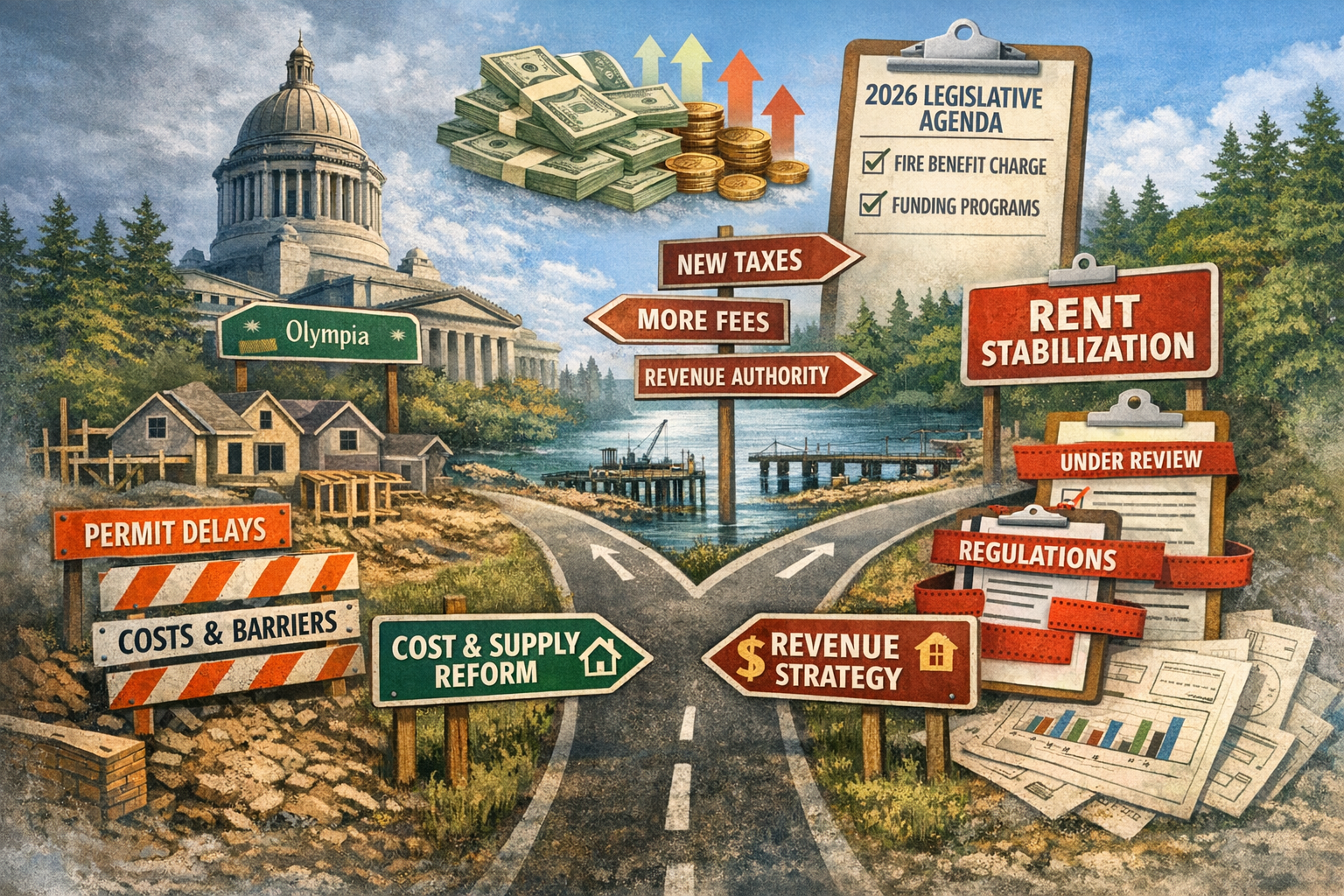
When examined more closely, most of the agenda’s concrete requests focus on revenue collection and program funding rather than cost reduction or system reform.
None of the major requests are aimed at shortening permitting timelines, reducing development fees, limiting appeal exposure, or improving the predictability of housing approvals. None directly address the regulatory and process barriers that determine whether housing can be built at a price people can afford.
This distinction matters. Revenue strategies manage the consequences of high costs. Cost and supply reforms address their cause.
The Fire Benefit Charge as a Signal
The proposed revival of a Fire Benefit Charge is especially instructive.
In 2023, voters rejected a Regional Fire Authority proposal that included such a charge. Rather than reassessing service delivery models, regional coordination, or cost structures, Olympia is now asking the Legislature for new authority to return a similar concept to the ballot under different legal rules.
From an affordability perspective, the implication is straightforward. Fire Benefit Charges function as quasi-property taxes. They raise costs for homeowners, renters, and small businesses at a time when household budgets are already strained by rising housing, insurance, utility, and transportation expenses.
This approach treats affordability as a revenue gap to be filled, not a cost problem to be solved.
Housing Reform Has Happened, but It Was Not Enough
Any honest analysis must acknowledge that the Legislature has already taken meaningful action on housing.
Recent sessions produced reforms addressing permit timelines, missing middle housing, and the use of objective standards. These changes mattered. They expanded what is legal to build and reduced some discretionary risk. Olympia and other cities have invested substantial effort implementing these requirements.
But progress does not equal resolution.
Despite these reforms, affordability has continued to deteriorate. That does not mean the legislation was misguided. It means it was incomplete and, in some cases, offset by other policy choices.
Permit timelines still stretch through serial completeness reviews and appeals. Missing middle housing is legal in more places, but feasibility remains constrained by fees, parking requirements, utility costs, and review uncertainty. Objective standards exist, but interpretation often remains subjective in practice.
Permission without predictability does not produce supply.
Policies That Undercut Reform Gains
At the same time reform bills passed, other policies increased cost and risk.
Environmental review expansion, layered climate mandates, rising infrastructure costs, growing impact fees, and tighter concurrency requirements all added pressure to the housing cost stack. Well-intentioned protections often produced unintended effects, including fewer small builders and fewer modest-scale projects that traditionally provided naturally occurring affordable housing.
The result is a system pulling in opposite directions.
State Rent Stabilization and Local Policy Layering
State-level rent stabilization further alters the affordability landscape.
Rent stabilization does not reduce the cost of producing housing. It regulates price growth after units already exist. In doing so, it changes the risk profile of rental housing, particularly for small landlords and missing middle developers.
When rent growth is constrained without corresponding reductions in permitting time, regulatory cost, or construction expense, predictable outcomes follow: higher starting rents, reduced reinvestment, and fewer new rental projects.
Within that framework, Olympia’s local rental registry adds another layer of cost and compliance. Registries do not create housing or shorten timelines. They increase administrative burden and enforcement exposure, particularly for small providers.
Layered together, these policies compound risk without expanding supply.
Capital Projects and Affordability Tradeoffs
The Deschutes Estuary Project highlights a broader prioritization issue.
Olympia is supporting more than 25 million dollars to complete project design by 2027. That request may be defensible on environmental grounds, but it underscores a recurring tension. Long-horizon, discretionary capital projects advance while near-term affordability drivers remain unaddressed.
Design work does not reduce rents. It does not shorten permit timelines. It does not unlock buildable land. Yet it competes for attention and resources in a period defined by fiscal constraint.
Transportation priorities show similar dynamics. Many projects may have long-term value, but few directly reduce household transportation costs or improve affordability in the near term.
What Serious Intent on Affordability Would Look Like
A legislative agenda truly centered on affordability would look different.
It would build on existing reforms and focus on the remaining gaps:
Treating time as a housing cost and advocating for enforceable permit timelines and consolidated review
Expanding by-right approvals where objective standards are met
Prioritizing infrastructure investments that unlock housing capacity, with measurable unit outcomes
Improving fee transparency, predictability, and payment timing
Pairing homelessness funding with accountability and throughput
Treating new revenue authority as a backstop rather than a first response
This approach does not reject environmental goals, tenant protections, or fiscal responsibility. It insists on sequencing and alignment.
Managing Versus Solving
Olympia’s 2026 legislative agenda does not represent a sudden shift away from affordability. It represents continuity.
Affordability is the headline. Revenue flexibility is the solution. Cost drivers are acknowledged but largely untouched. Housing and homelessness are treated as systems to manage rather than problems to unwind.
That is not a question of values. It is a question of outcomes.
Until affordability is addressed as a cost and supply problem, not just a funding and management challenge, the pressure will persist. Olympia’s agenda makes that reality visible. What happens next will determine whether the region continues managing the crisis or begins to solve it.
